
I’ve spent six years working in digital marketing. During that time, I’ve watched small local shops grow into well-known names and big international brands double their sales—all because of digital marketing. Today, it’s not just a bonus; it’s essential for your business to survive and grow.
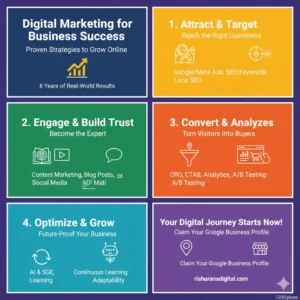
In this guide, I’ll explain why digital marketing is important and share strategies to help your business grow. I’ll keep things straightforward, honest, and focused on what really works.
Here’s what you can expect to learn:
-
The key reasons digital marketing is essential for business growth
-
How to reach the right customers and make every penny count
-
Steps to boost your visibility with SEO
-
How to use paid ads for quick results
-
Ways to use content marketing to build trust and expertise
-
Simple techniques to turn website visitors into customers
Let’s dive in and break down these steps so you can put them into action right away.
1. Why Digital Marketing Is the Most Important Thing for Your Business
When I started in digital marketing, I often heard people ask, “Aren’t big billboards better than all this online stuff?” I understand—there’s something exciting about seeing your logo on a busy street. But here’s what I’ve learned: digital marketing isn’t just an updated version of old methods. It’s a completely new approach that gives small businesses a fair shot. Traditional marketing, like billboards, radio jingles, and magazine ads, is like throwing a big net into the ocean, hoping to catch the right fish. Most of the time, you don’t even know if your target audience sees your message. You just spend money and hope for the best.
Digital marketing changes this completely. It lets you:
-
Precisely target your ideal customer based on interests, age, location, online behaviors, and even life events.
-
Track every interaction, from the first website visit to the moment they make a purchase.
-
Adjust your campaigns in real time. If something isn’t working, you can pause, tweak, and relaunch right away without waiting for the next print cycle.
-
Scale up or down with your budget, focusing resources on what drives results.
Here’s a story about a client—a small bakery that was almost empty on weekdays. We ran a few simple Facebook and Instagram ads targeting nearby people and promoted a weekday lunch special. I still remember the owner’s reaction when, just two months later, almost every table was full at lunch. The best part was that we could see exactly which ads worked and which didn’t, so every rupee spent really counted. That’s the power of digital marketing: you know what’s working and can make quick changes.
1.1 Digital Marketing: Finding Your Ideal Customers
Traditional advertising is like firing a shotgun—you hope to hit something. Performance marketing is more like a laser, targeting people who just searched for specific terms on Google. When someone types “Hire Digital Marketing Consultant” or “Professional SEO Services,” they’re ready to buy. Digital marketing helps you be the answer they find.
Let’s break it down:
-
Search Engine Marketing (SEM) and Social Media Advertising let you target people with purchase intent. For example, Google Ads can show your business at the very top of results exactly when someone is ready to purchase.
-
Behavioral targeting means you can show ads to people who have visited your website, interacted with your social media, or even watched a portion of your videos. This increases the chance of conversion because your message is always relevant.
A real-world example: An e-commerce clothing brand I worked with used Google Shopping Ads to target buyers searching for “affordable party dresses.” We saw a 5x return on ad spend within 3 weeks by matching intent and timing perfectly.
Counting Every Last Rupee
One of the best parts of my job is working with data. In the past, if you placed an ad in a magazine, you couldn’t tell how many people bought because of it. But with Google Analytics 4, I can see exactly where customers came from, what they looked at, and why they bought or didn’t. So, we don’t guess—we know for sure.
How do we use this? Every campaign is an experiment. We launch, measure, and learn. For example, if we run two ads—one with a discount offer, one with a free shipping offer—we know within days which one drives more sales. That means you spend less and earn more.
Pro tip: Set up “Goals” in Google Analytics and connect it to your ad platforms. This lets you track every lead, sale, newsletter signup, or phone call. If you’re new to this, Google Analytics offers a step-by-step Goals setup wizard under the Admin section, and you can find beginner tutorials in the Google Analytics Help Center. This detailed tracking helps you improve over time.
Leveling the Playing Field
I’ve seen small businesses beat big companies by being better at targeted lead generation. You don’t need a million-dollar budget to win—you just need to be more useful and relevant to your audience than the big players.
2. The SEO Engine—How to Get Free Traffic for Years
If you want your business to grow even while you sleep, you need to understand Search Engine Optimization (SEO). It’s a long-term strategy that pays off over time.
Think of SEO as building a digital asset for your business. While paid ads bring quick results, SEO is like planting a tree that keeps giving fruit for years. The higher you rank in search engines, the more “free” traffic your website gets—month after month, year after year.
Why is this so powerful?
-
Over 90% of online experiences begin with a search engine.
-
Organic search results are trusted more than paid ads.
-
The traffic you earn through SEO is highly targeted and more likely to convert.
A story from my experience: I helped a local legal firm create in-depth guides answering common questions about property law. Within six months, those pages brought in hundreds of new leads—without spending a rupee on ads.
2.1The Secret of Keyword Intent in Digital Marketing
Not all website visitors are valuable. If I rank for “free marketing tips,” many visitors might not buy anything. But ranking for “High-Conversion Digital Marketing Strategy” attracts serious business owners who want to learn and take action.
-
Commercial Intent: People who want to find the “Best Digital Marketing Expert in India” or compare services. This is where the cash is.
2.2How to Get Google to Love Your Website
Your website needs to be fast and easy to use to rank well. Since 2026, Google has focused a lot on Core Web Vitals. These are metrics that measure user experience, such as how quickly your pages load, how quickly people can interact with your site, and how stable the content is while loading. If your site is slow on a phone, you’ll lose ranking. I always use a Mobile-First approach because that’s where your customers are.
3. Pay-Per-Click (PPC) Advertising
SEO takes time, but Pay-Per-Click (PPC) advertising works like a faucet—you turn it on, and leads start flowing. I’ve seen how powerful this can be when done right, having run campaigns for international watch brands.
3.1 Managing Google Ads
Google is the best at “Intent.”
-
Search Ads: These ads appear at the top of Google results when someone is actively searching for what you offer. For example, you might target terms like “Google Ads Specialist for Watch Brands” or “E-commerce Growth Expert.” Search Ads are best when you want to reach people who already have buying intent and are looking for solutions like yours.
-
Performance Max (PMax): A newer ad type that uses Google’s AI to show your ads across all Google channels, including Search, YouTube, Gmail, and Display. You set your goals—such as leads or sales—and let Google’s automated system find the best placements and audiences for you. This campaign type helps you reach customers wherever they spend time online, not just on Search. If you want to maximize results across multiple platforms without constantly managing each one, Performance Max is a strong choice.
3.2 Meta Ads (Instagram and Facebook)
On Facebook, we’re not targeting people who are searching; instead, we focus on people who match a specific profile.
-
Interest targeting: I can show ads to people who own a small business or love luxury watches.
-
Remarketing ads: One of the best strategies is to show a friendly reminder ad on Instagram to people who visited your site but didn’t make a purchase. This often turns a “maybe” into a “yes.”
4. Digital Marketing Content Marketing—Becoming the Expert
People buy from those they trust. You build that trust through content marketing by sharing helpful blogs, short videos, or advice that shows you know your stuff.
4.1 Why a Strategic Blog Is the Most Important Business Tool
A blog is more than an online diary—it’s a way to show your deep industry knowledge. Publishing detailed, helpful guides doesn’t just share information; it builds “Topical Authority.” Sites that provide complete, useful answers rank higher. Diving deep into a topic shows both your audience and search engines that you’re a trusted expert.
For example, if you want to be known as a top SEO expert, write about the technical side of SEO in a way that’s easy to understand. This helps you build “Topical Authority.”
5. Conversion Rate Optimization (CRO): Don’t Waste Traffic
Getting people to your site is only half the battle. The other half is convincing them to take action. This is called optimizing your conversion rate.
Imagine you own a real store. One hundred people come in, but none buy anything. You wouldn’t just try to get more visitors; you’d want to find out why those 100 didn’t buy.
-
Clear Call-to-Action (CTA): Is it easy to find your “Contact Us” or “Buy Now” button?
-
Trust signals: Do you have reviews or testimonials?
-
Simple forms: Don’t ask for more than a few details. Just ask for their name and email.
6. How to Start Today
If you’re feeling overwhelmed, take a deep breath. You don’t have to do everything at once. Here’s the order I usually suggest:
-
Set up a Google Business Profile. This is one of the most important first steps for local businesses because it helps you show up in Google Maps and local search results. It only takes a few minutes and makes it easy to find online.
-
Claim Your Local SEO: Make sure Google Maps shows you.
-
Start one paid channel: Use a small budget on Google Search Ads to find out what people are looking for.
-
Write: Every week, write one long, good piece of content.
7. What’s Next for Digital Marketing Growth
In the future, AI will help us find customers more than ever. But it can’t replace the human touch. The companies that succeed will be those that use data-driven marketing while still connecting with customers like real people.
7.1 Things I Want to Set Straight
-
“I’m too small for Digital Marketing”: No business is too small to have a Google profile.
-
“Social Media is free,” but it costs time, and your most valuable asset is time.
-
“SEO is like going to the gym: it’s something you do once. You lose your progress if you stop.
Why a Strategic Blog Helps Your Digital Marketing
You have to keep learning and testing in digital marketing. Over six years, I’ve seen it change lives and businesses. The key is consistency, whether you’re using SEO to generate free leads or Facebook Ads to drive quick growth.
I hope this guide has made digital marketing feel less daunting. The key is finding the right people, offering them real value, and making it easy for them to say yes to your business.
Do you have a plan for the rest of the year? To begin, you need to know your customer and have the right tools to reach them. If you need a simple starting point, claim your Google Business Profile today. This will help you show up in local search results and make it easier for customers to find you online. There are many opportunities in the digital world. Go out and get yours!