
In my more than 6 years of working in digital marketing, I’ve seen many trends come and go. But the basics of success on Google never change: we have to meet the search engine’s needs and deliver clear value to users. Search Engine Optimization (SEO) is the major way I help businesses grow. Following Google’s algorithms is a step-by-step process that ensures your website is the most relevant answer to a user’s question. It’s not magic.
When you look at a web address, which is also called a URL (Uniform Resource Locator), you can just see a string of letters and numbers. But as a specialist, I see a map. For example, the URL -https://www.fb.com/pages/ shows me Facebook, WWW is the World Wide Web, the protocol (HTTPS—Hyper Text Transfer Protocol Secure), the domain type (.com), and the slug (pages). The search engine sees a story in each of these parts.
This complete tutorial will describe my whole strategy for ranking websites, including the technical “under-the-hood” work and the “human-first” content strategies.
The Basics: Understanding How Search Engines Work
To have a good rating, you need to know how search engines like
Google (USA),
Bing (USA),
Yandex (Russia), or
Baidu (China) works.
I normally show my customers how to do this in four simple steps:
- Google uses “bots” or “spiders” to crawl the web and look for new and updated content.
- To save your website, the bot sends a “snapshot” of it to the database (DB).
- Indexing: Google adds your site to its vast “library,” where it can be found and saved.
Search Engine Results Page (SERP): When someone searches on Google, it shows them the best results it finds.
You can use the command site:yoururl.com to check whether your page is in Google’s index. If you don’t have it, it means your crawling or indexing is broken, and no amount of good content will help.
Google’s Guide to Using the Algorithm
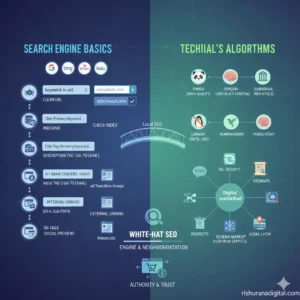
Google uses algorithms, which are sets of rules, to sort through the internet. To keep my clients happy throughout the years, I’ve had to learn how to do these updates:
Panda: This update puts a lot of weight on high-quality content. Websites with a lot of high-quality, original content are rewarded, whereas those that engage in “content farming”—low-quality, shallow content—are punished. Panda can find you if you use inappropriate language or have too many ads on your site.
Penguin: This targets sites that use “Black Hat” methods or fake link schemes to try to manipulate results.
Hummingbird helped Google better understand intent. Word matching is simply one part of it; matching the searcher’s goal is another.
RankBrain is the name of this machine learning tool. It lets the engine understand which results are most relevant based on how users interact with it.
Page Experience (Core Web Vitals) is what people expect these days. Google gives your website a score between 1 and 10 based on how stable and responsive it is and how fast it loads (CLS, or Cumulative Layout Shift).
BERT: Is the grammar and context right to understand the intent of the user? They can give the most accurate answers because they understand the context of human language.
MUM: Search the image in the Google image query form on Google. It helps the MUM; it understands image query, voice, and video
Choosing Your Course: The Three Ways to Do SEO
I only use white-hat SEO in my business. So, we follow Google’s regulations to the letter. It takes six to seven months to see big profits, but it builds a business that lasts.
“Grey hat” is what you call it when you mix dangerous and safe techniques. It might work in a month or two, but there’s a chance it won’t be allowed.
“Black hat” is what people call cheating the system. Your domain might rank in 15 days, but Google will eventually catch up and blacklist it for good.
Keyword Power: Starting with Intent
Keywords link the user to your business. They can be put into one of two main groups—
Seed keywords (short-tail): two to three terms that are quite broad. “Digital Marketing” is one example. Even though they have many fans, they are very competitive.
Long-tail: More than three words. “Digital marketing course for beginners” is one example. Even though they are going after a smaller group of people, they have a far higher conversion rate.
The Searcher’s Mind Map: I chose ‘intent’ instead of ‘words.’
Informational: “How to start SEO?” The user is getting smarter.
Commercial: The ad says, “Best laptop under 15k” (the buyer is comparing).
Transactional: “Buy Adidas shoes” (the user is ready to pay).
These are words that mean the same thing or are related to each other.
They are part of LSI (Latent Semantic Indexing). They help Google comprehend your area of expertise without you having to use the same word again.
The Ultimate List for On-Page SEO
On-page SEO includes all the adjustments we make to your website. For each page that I score, I utilize the following personal checklist:
Improving the URL
A bot sees the URL first. My rules are really tight.
You must always include your core keyword and not include any numbers or spaces.
You should use a hyphen (-) to separate words. Clean URLs are ranking URLs.
The blue link on the SERP is called the title tag. Don’t write more than 60 or 70 characters. When I can, I start with the main term. The “description tag” is a summary that comes after the title tag. It should be between 160 and 170 letters long.
The alt tag tells the bot what the picture is about because crawlers can’t “see” it. This is what determines your ranking in picture searches.
How to Use Headings Tags: – Six types of heading tags (H1-H6)
Headings are the structure for your material.
H1: This should be your main title. I propose using your main keyword in this scenario. Some people say to only use it once, but I make sure it clearly shows that the page is a “P”illar or long-form content. But now we can use it 3 times on a page. Always use the primary keyword in the H1 title tag.
These are your main chapters, H2. I use two to three H2 tags for a blog post that is 1,000 words long.
H3–H6: These are for small details and sub-points.
The Advanced On-Page SEO: A canonical tag helps us identify the “preferred web version” of your page and prevents duplicate content. It generates the authority of that web page. It is always a permalink of that page
Using OG (Open Graph) tags ensures the preview looks good when you share your link on social media.
Internal linking: When we connect two web pages on the same domain, we use internal linking.
External linking: When we connect two domains or webpages, it is called external linking.
Using technical SEO to fix the engine
If your technical SEO isn’t working, your “pretty” website won’t show up in search results.
SSL (Secure Socket Layer) technology changes HTTP to HTTPS. It is a basic security signal required for ranking.
Using 302 for temporary moves and 301 for permanent ones will help you avoid the 404 Forbidden Error.
I publish sitemaps in HTML so my users can view them and in XML so crawlers can follow them.
The robots.txt file tells the robots where they can and can’t go. This hides private pages, such as your “Admin” or “Payment Gateway” panels.
ORG “Organization Schema” and “Local Business Schema” are two more names for schema markup. It also helps Google display “rich snippets” on the search results page, including your location, reviews, and breadcrumbs.
Local SEO: Taking Control of the Neighborhood
If you own a local business, like a restaurant, grocery store, or hair salon, you have “low radiance” consumers. Local SEO is your secret weapon. It lets small businesses take over their own city or neighborhood, and you may be able to rank for “Near Me” searches.
Content Optimization: Things I Won’t Give Up
As a person who is building a professional portfolio on rishuranadigital.com, I follow these rules when I write blogs:
You should never post information that is copyrighted or “spun.” Google’s BERT algorithm can’t do that.
Never copy someone else’s work, no matter what.
Use human-first content instead of raw AI all the time. AI is useful to people even though it is a tool.
Length Is Important: To show that you know what you’re talking about, your blog should be at least 1,500 words long. I strive to make my pillar posts at least 3,000 words long so that they cover all the bases.
To sum up, the Conversion Path
SEO isn’t just about getting to the top of the page; it’s also about staying there and turning visitors into customers. Google loves, and users trust, a website that has technical schema, on-page optimization, and high-intent keyword research all in one place.
Even as digital technology evolves, especially with the rise of Search Generative Experience (SGE) and AI SEO, the ideas of authority and trust remain the same. Every step you take, whether it’s submitting your first XML sitemap or fixing your URL structure, will help you become the best search engine.